 FR


Tomographic cross-section
dimensions measured inside the assembly
X-ray tomography, acoustic microscopy, SEM-EDX and 3D metrology: INSIDIX inspects your implants and medical devices without destroying them, in Grenoble.
Medical
Professionals in the medical sector must meet a high level of requirements. At INSIDIX, we ensure the quality of implants, stents and other medical devices thanks to X-ray tomography. This technology allows us to observe the inside of a part without destroying it, to check its dimensions and to look for the slightest defect before it goes on the market or after a field return.
We provide medical device manufacturers and notified bodies with a laboratory bringing together all the imaging and metrology techniques needed for this level of requirement: high-resolution X-ray tomography, electron microscopy (SEM/EDX), 3D metrology with a coordinate measuring machine (CMM) and composition analysis by XRF.
To go further: discover our non-destructive testing (NDT) expertise, our 3D and surface metrology services and TDM technology for deformation measurement under temperature.
Your challenges
Quality control
A medical device leaves no second chance: every implant, every stent, every instrument must meet strict dimensional specifications and be free of defects. By combining non-destructive imaging techniques and in particular X-ray tomography, INSIDIX carries out high-precision quality control: verification of dimensions by internal metrology, search for cracks, inclusions, porosity or fractures, and validation of compliance before lot release.
This approach covers the entire quality control chain, in support of the quality requirements of your sector (notably ISO 13485, applicable to medical device manufacturers), from the elementary component to the assembled device.
| Suspect lot before release | Reliable decision (acceptance / rejection) |
|---|---|
| Failure or field return | Identification of the root cause |
| New device to qualify | Dimensional inspection and defect search before market launch |
Case · Metrology by X-ray tomography
A manufacturer of injection medical devices entrusts us with five assembled devices. Objective: verify 18 dimensions (distances, diameters, radii, angle), including inside the closed assembly, without dismantling or cutting anything. X-ray tomography reconstructs each device in 3D, and the dimensions are measured directly on the volume.
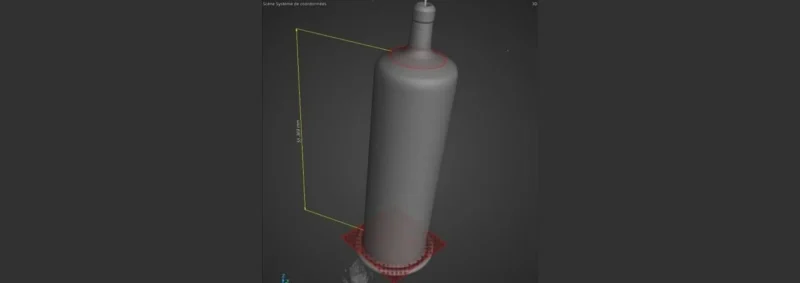
| Method | High-resolution X-ray tomography (XTH225ST tomograph, 40 µm resolution) and measurement of dimensions on the 3D volume, in a room at 20 °C. |
|---|---|
| Dimensions measured | 18 dimensions: distances, diameters, radii and cone half-angle, measured on each of the 5 devices. |
| Results | For each dimension: the value on each device, the mean and the standard deviation. The most stable dimensions vary by a few microns to a few tens of microns from one device to another; others stand out more clearly. |
| Deliverable | Inspection report with a view of each measured dimension in an appendix, to best assess any defects. |
Implants
Osteosynthesis screws, joint prostheses, active implants: once fitted, these devices tolerate no dimensional approximation and no hidden defect. INSIDIX combines X-ray tomography and CMM metrology to cover both dimensional inspection and defect detection on implants and prostheses.
For the bone/implant interface, electron microscopy analysis (SEM/EDX) makes it possible to study contact areas and the quality of osseointegration precisely.
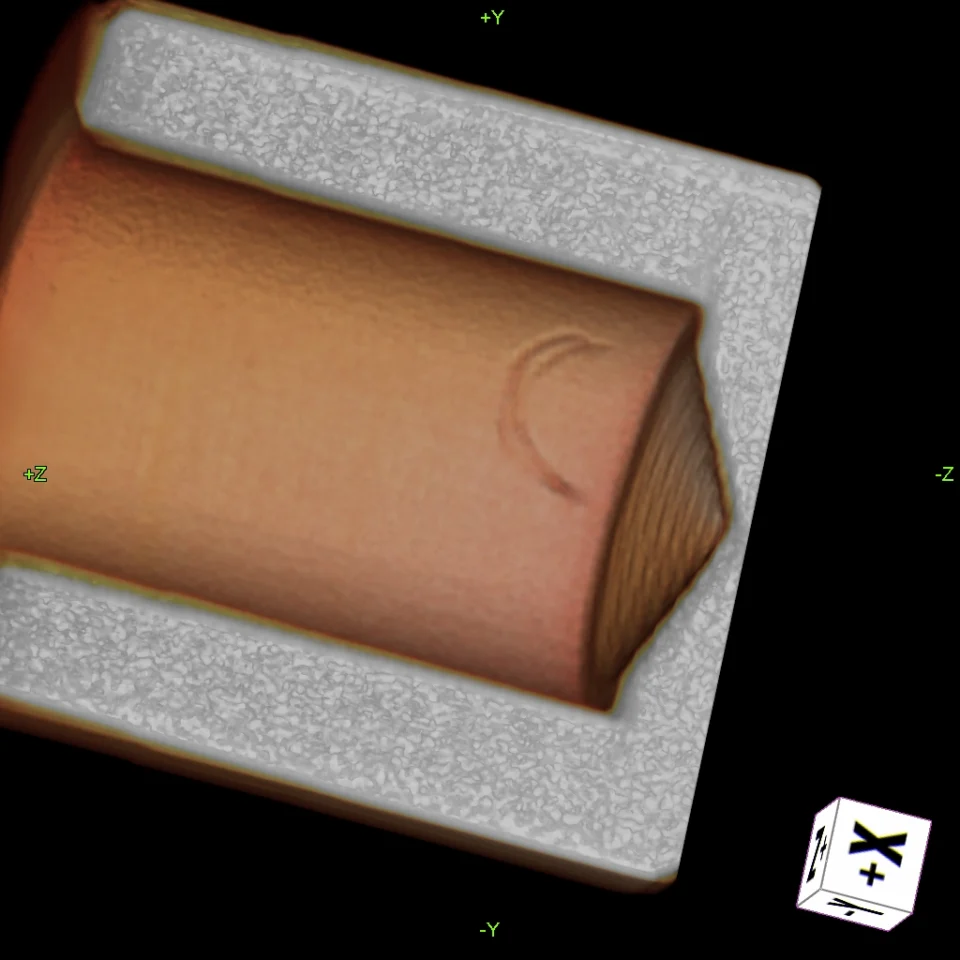
A crack or porosity invisible on the surface can compromise the mechanical strength of an implant. X-ray tomography and 3D reconstruction reveal these internal defects before they become critical.
Failure analysis
When an implant or medical device fails, the challenge is to identify the cause quickly and precisely. INSIDIX applies a failure analysis methodology combining the techniques best suited to the type of device and the defect sought.
The results obtained make it possible to guide technical hypotheses, secure a quality decision and, where applicable, feed a materiovigilance file, in support of your quality file (notably ISO 13485, applicable to medical device manufacturers).
Metrology
Beyond implants, INSIDIX puts its 3D metrology fleet at the service of surgical instruments and endoscopy devices: coordinate measuring machine (CMM) for dimensional inspection by physical or optical probing, X-ray tomography for complex internal geometries not accessible with conventional metrology, and OCT for the inspection of films and coatings.
These resources make it possible to secure the dimensional compliance of reusable instruments as well as single-use devices, as part of supplier quality control or the qualification of new tools.
Case studies
Real analyses carried out in the laboratory, presented anonymously: the problem, the method and the results.
INSIDIX
INSIDIX brings together in one place all the technologies needed for the quality control of medical devices: high-resolution X-ray tomography (below 1 µm), SEM/EDX electron microscopy, 3D metrology (CMM) and XRF composition analysis. This combination avoids multiplying suppliers and guarantees consistent, fast and actionable analyses, across the entire inspection chain, in support of your quality file (notably ISO 13485, applicable to medical device manufacturers).
Based in Grenoble since 1996, the INSIDIX laboratory supports medical device manufacturers and notified bodies, from the elementary component to the assembled device, whether to qualify a new implant, analyse a failure, control quality in production or secure a lot release.
 ISO 9001-certified laboratory
Traceable reports and guaranteed confidentiality for your medical devices.
 Multiple techniques combined
X-ray tomography, SEM/EDX, 3D metrology and XRF analysis in one place.
 Confidentiality and responsiveness
Systematic NDA and short lead times, in Grenoble since 1996.
Discover our laboratory analysis capabilities, our complete equipment fleet, our Nikon Metrology tomography systems or our expertise in SAM acoustic microscopy. For failure analyses, see our forensic expertise page. You can also find our quality certifications and accreditations.
INSIDIX combines several complementary techniques depending on the objective of the inspection: high-resolution X-ray tomography (below 1 µm) for internal metrology and defect search (cracks, inclusions, porosity, fractures), SEM/EDX electron microscopy for the analysis of interfaces such as the bone/implant interface, CMM metrology for external dimensions, and µXRF analysis for metal composition and biocompatibility.
Yes, X-ray tomography and the other techniques used by INSIDIX are non-destructive: they make it possible to observe the inside of an implant, stent or medical device, check its dimensions and look for defects without altering the part, which is essential before lot release or as part of a failure analysis.
The INSIDIX laboratory works on orthopaedic implants and prostheses, stents, osteosynthesis screws, active medical devices and MEMS packages, as well as surgical instruments and endoscopy devices, for medical device manufacturers and notified bodies.
Yes. INSIDIX provides traceable analysis reports (annotated images, measurements, documented verdicts) that its customers can include in their quality file, notably within the framework of ISO 13485, applicable to medical device manufacturers. The laboratory is ISO 9001:2015 certified.
INSIDIX carries out µXRF analyses to determine the composition of the metals used (titanium, stainless steel, CoCr) and detect any metallic contamination, on metallic as well as plastic and organic samples, in order to validate the quality of products before they go on the market.
Yes, INSIDIX applies a failure analysis methodology combining X-ray tomography, SEM/EDX and µXRF analysis to identify the cause of a failure observed in production or after a field return, and to guide the quality decision or the materiovigilance file.