 FR

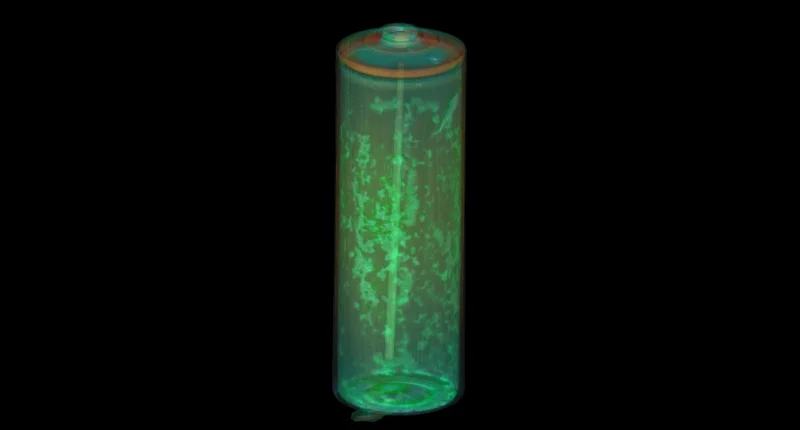
3D view
reconstruction of the cell
X-ray tomography, Lock-In thermography and acoustic microscopy: INSIDIX inspects welds, batteries and power modules, in Grenoble.
Energy & power
In the energy sector, the most critical defects are often invisible to the naked eye: porosity in welds, delaminations in power components, internal cracks in rotors, foreign bodies in batteries, insulation defects in high-voltage cables…
The slightest error, the slightest approximation on a piece of equipment, can have dramatic consequences.
Faced with demanding standards (RCC-M nuclear, ASME) and significant safety stakes, INSIDIX supports energy players (nuclear, wind, storage, petrochemicals) to inspect their equipment, identify defects, qualify their assemblies and understand the root causes of a failure.
To go further: discover our non-destructive testing (NDT) expertise, our 3D and surface metrology services and TDM technology for deformation measurement under temperature. Batteries and energy storage are also covered on our automotive sector page.
Your challenges
Quality control
By combining non-destructive imaging technologies — 320 kV high-energy CT, ESRF synchrotron for large parts, weld radiography, acoustic microscopy (SAM), laser metrology — INSIDIX teams access the inside of energy equipment without destroying it, whatever its size or density.
We identify the real defects, you understand their impact on the reliability and safety of the installation, and you make an informed decision.
INSIDIX also supports the qualification of new components (batteries, power modules) and new assembly processes, with tests combining non-destructive analyses (CT, SAM), metrology and metallographic cross-sections when necessary.
| Production or operation blocked | Quick diagnosis to secure the restart |
|---|---|
| Doubt about a lot or a component | Reliable decision (acceptance / rejection) |
| Recurring problem in operation | Identification of root causes |
| New component, new assembly | Process qualification (RCC-M, ASME) |
Example · X-ray tomography
Volumetric reconstruction makes it possible to observe the internal stacking of the electrodes and to detect assembly defects, deformations and foreign bodies, without opening or destroying the cell.
Tomographic cross-section of an electric bike battery pack, scrolled slice by slice using the position slider (bottom right). Each cell can be seen from the inside and, on the right-hand side of the module, burst cells.
In detail · X-ray tomography
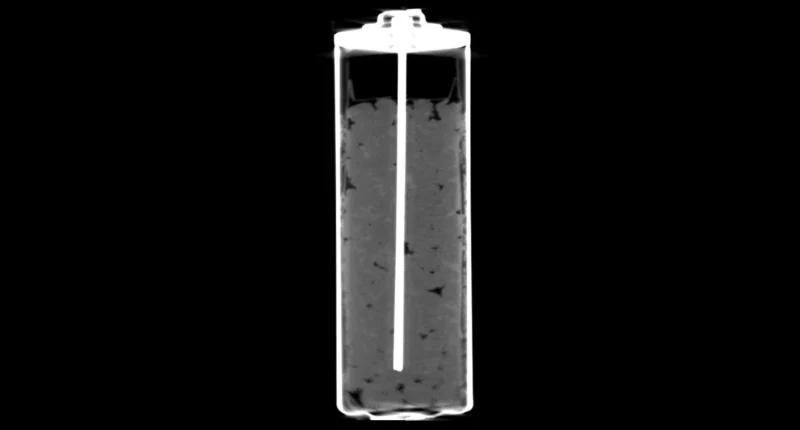
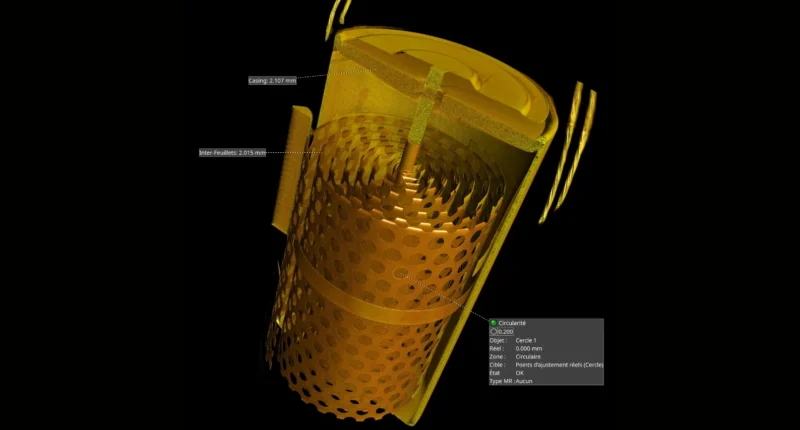
Three examples of what the analysis delivers: a 3D reconstruction of the cell, a longitudinal section of its internal structure and dimensional measurements within the volume, without opening it.
Inspection resources
| High-energy CT 320kV | Internal inspection of dense, large metallic structures |
|---|---|
| ESRF synchrotron | Parts up to 2m / 300kg, resolution down to 10 nm voxel |
| Weld radiography | Porosity, lack of fusion, cracks, RCC-M / ASME compliance |
| Acoustic microscopy (SAM) | Delaminations, interface defects |
| Laser metrology | Scanning of large parts, dimensional inspection |
These resources make it possible to inspect turbine welds, pipeline defects, the integrity of wind turbine blades or rotors, with a level of detail impossible to obtain with destructive methods or surface inspection alone.
Failure analysis
When a breakdown or incident occurs on energy equipment, the challenge is not only to note the defect, but to quickly identify its cause in order to secure operation and prevent recurrence.
This methodology applies equally to a weld defect on a pipeline, a power battery failure or a crack in a turbine component.
Metrology
High-voltage cables and insulators are exposed to electrical and thermal stresses that can generate defects invisible on the surface: porosity, foreign bodies, delaminations or homogeneity defects in the insulating material.
INSIDIX applies its imaging and metrology technologies to:
This upstream inspection reduces the risk of failure in operation, which is particularly critical on energy infrastructure where maintenance access is complex.
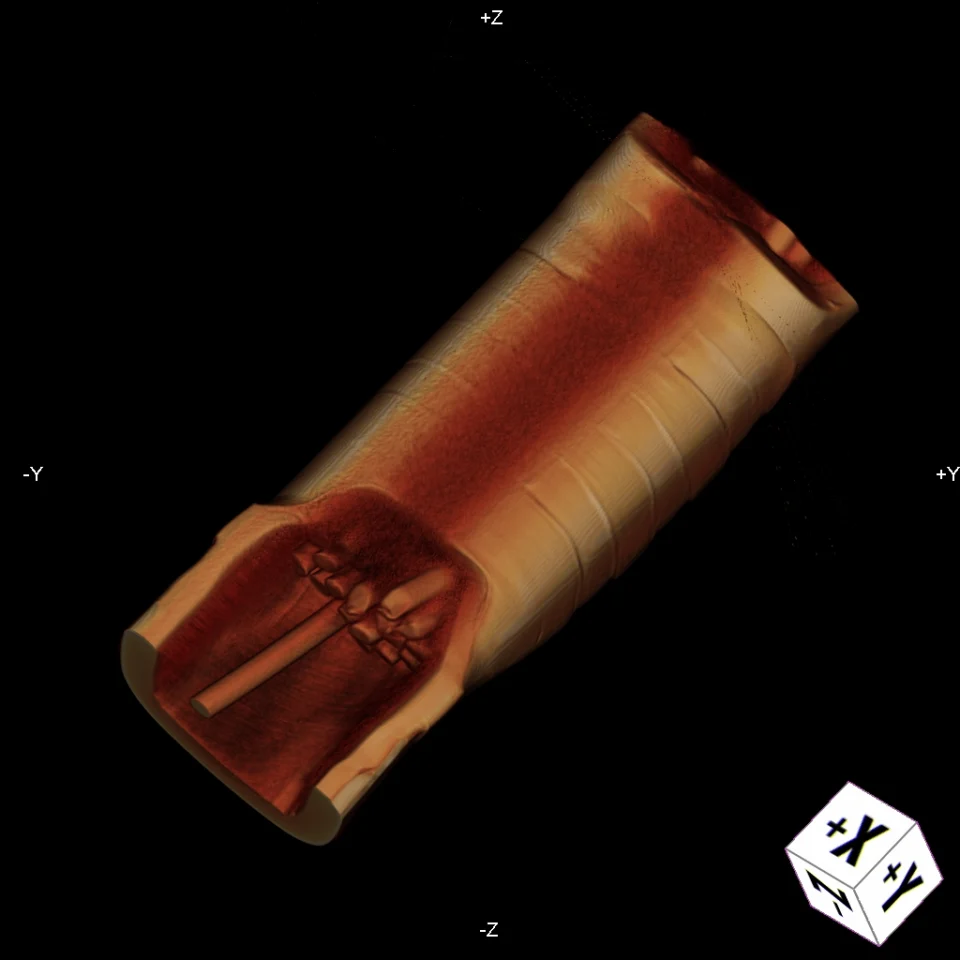
The volumetric cross-section reveals the arrangement of the conductors and the integrity of the insulation, and detects manufacturing or assembly defects over the entire length inspected, without destructive cutting.
Case studies
Real analyses carried out in the laboratory, presented anonymously: the problem, the method and the results.
INSIDIX
INSIDIX combines advanced technologies and industry expertise to address the concrete challenges of players in nuclear, wind, energy storage and petrochemicals.
This ability to handle dense, heavy or large parts (up to 2m and 300kg) sets INSIDIX apart for the specific needs of the energy sector, where other laboratories remain limited to small components.
 Traceable and documented inspection
Detailed reports and usable measurement data for your qualification and maintenance files.
 Dense and bulky parts
Equipment fleet sized to inspect turbines, rotors and large metallic structures.
 Responsiveness and confidentiality
Systematic NDA and short lead times, in Grenoble since 1996.
All resources are brought together in one place, which guarantees consistent, fast and actionable analyses, with a direct impact: shorter diagnosis times, more reliable decision-making, improved assembly quality and reduced risks in operation.
This approach applies equally to the qualification of new equipment, the analysis of failures in operation, supplier quality control or securing a critical delivery compliant with RCC-M and ASME standards.
Discover our laboratory analysis capabilities, our complete equipment fleet, our Nikon Metrology tomography systems or our expertise in SAM acoustic microscopy. For failure analyses, see our forensic expertise page. You can also find our quality certifications and accreditations.
INSIDIX detects the defects commonly sought on critical welds in the energy sector through X-ray radiography: porosity, lack of penetration, cracks, inclusions. These inspections can be carried out according to the RCC-M (nuclear) and ASME standards, to guarantee the compliance of assemblies subjected to high pressure and temperature stresses.
Yes, INSIDIX has dedicated resources for large parts: a 320kV high-energy CT for dense metallic structures, and access to the ESRF synchrotron for parts up to 2m and 300kg with a resolution of up to 10 nm. This combination makes it possible to inspect wind turbine blades, rotors or turbine components that exceed the capabilities of conventional tomography equipment.
INSIDIX carries out construction analyses by tomography: visualisation of the layers and their stacking, filling inspection (levels, density, homogeneity), identification of foreign bodies or internal voids. For power modules, the laboratory also verifies the efficiency of heat dissipation, the quality of interfaces with baseplates and substrates, and can measure thermomechanical stresses by TDM.
Yes, INSIDIX carries out inspections aligned with the RCC-M (nuclear) and ASME standards, particularly for the inspection of critical welds. These standards guarantee that the analyses meet the safety requirements specific to energy installations.
After analysis, INSIDIX provides usable inspection results: analysis images (CT cross-sections, volume renderings, SAM C-scans), dimensional measurements and interpretation elements to guide technical decisions. These deliverables are designed to quickly support a quality, production or operating decision, notably when it comes to unblocking an installation, sorting a lot or securing a critical delivery.