 FR

Can you look inside an ancient sculpture without touching it? That is exactly what X-ray tomography carried out at the INSIDIX laboratory on the goddess Epona makes possible — a work from the collections of the Sens museums, supported by ARC-Nucléart.
The challenge: understanding the condition of a work without altering it
On 15 May 2025, a conservator from ARC-Nucléart, specialising in archaeology, brought the sculpture of the goddess Epona, from the collections of the Sens museums, to the INSIDIX laboratory so that it could benefit from a tomography scan.
Before any restoration, it is essential to understand what the work is made of and what condition it is in: materials, previous restorations, areas of fragility. The study had two objectives: to observe the previous restoration work in order to prepare the new one, and to gather clues about how the piece was made.
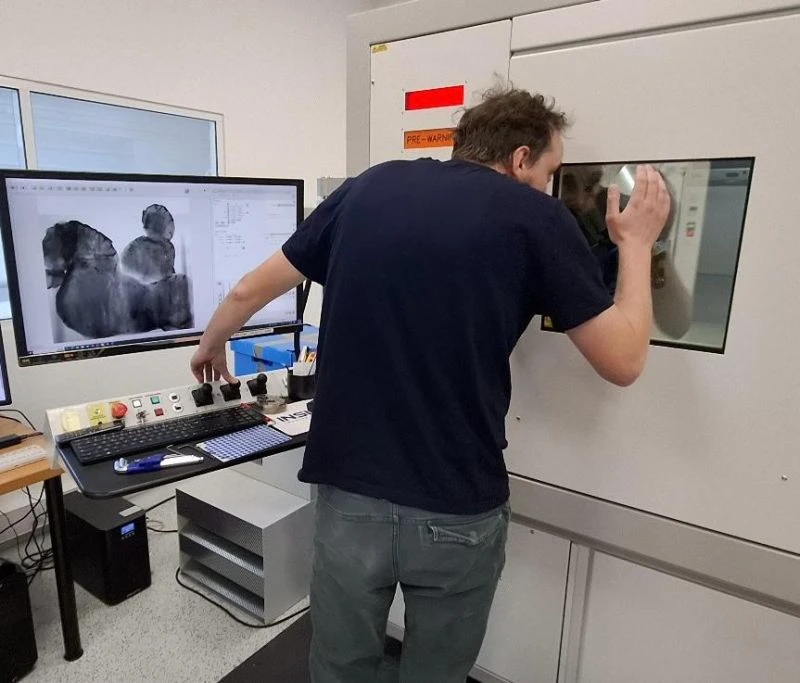
Inspection of the sculpture in the INSIDIX laboratory tomograph, with the projection image displayed on the control screen.
The method: X-ray tomography, more precise than a medical scanner
More precise than a medical scanner, this imaging technique makes it possible to explore the condition of the work in depth, without contact or removal of material. The sample is placed on a rotation stage, then reconstructed as a volume from thousands of projections. To find out more about this technique, see our industrial X-ray tomography page.
Two complementary techniques were used: 2D X-ray radiography (XT V 160) for an overall view, and 3D X-ray tomography (XT H 225 ST) to explore the volume. The entire statue was scanned at 90 µm, the head and rump zoomed at 60 µm, then the fragments (a leg, a hoof and a tail) at 48 µm. The results were viewed live on site with the conservator.
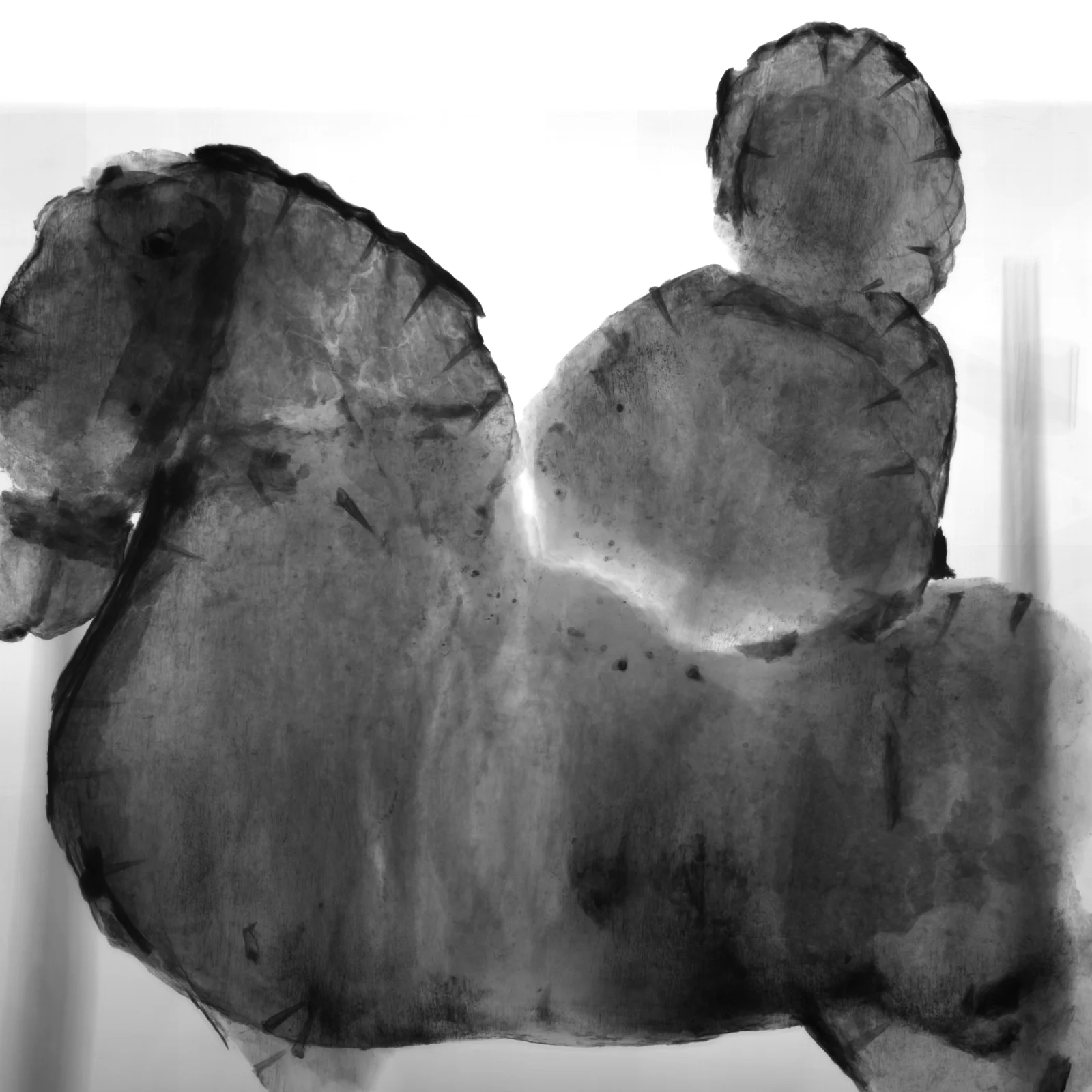
2D X-ray radiograph of the whole statue.
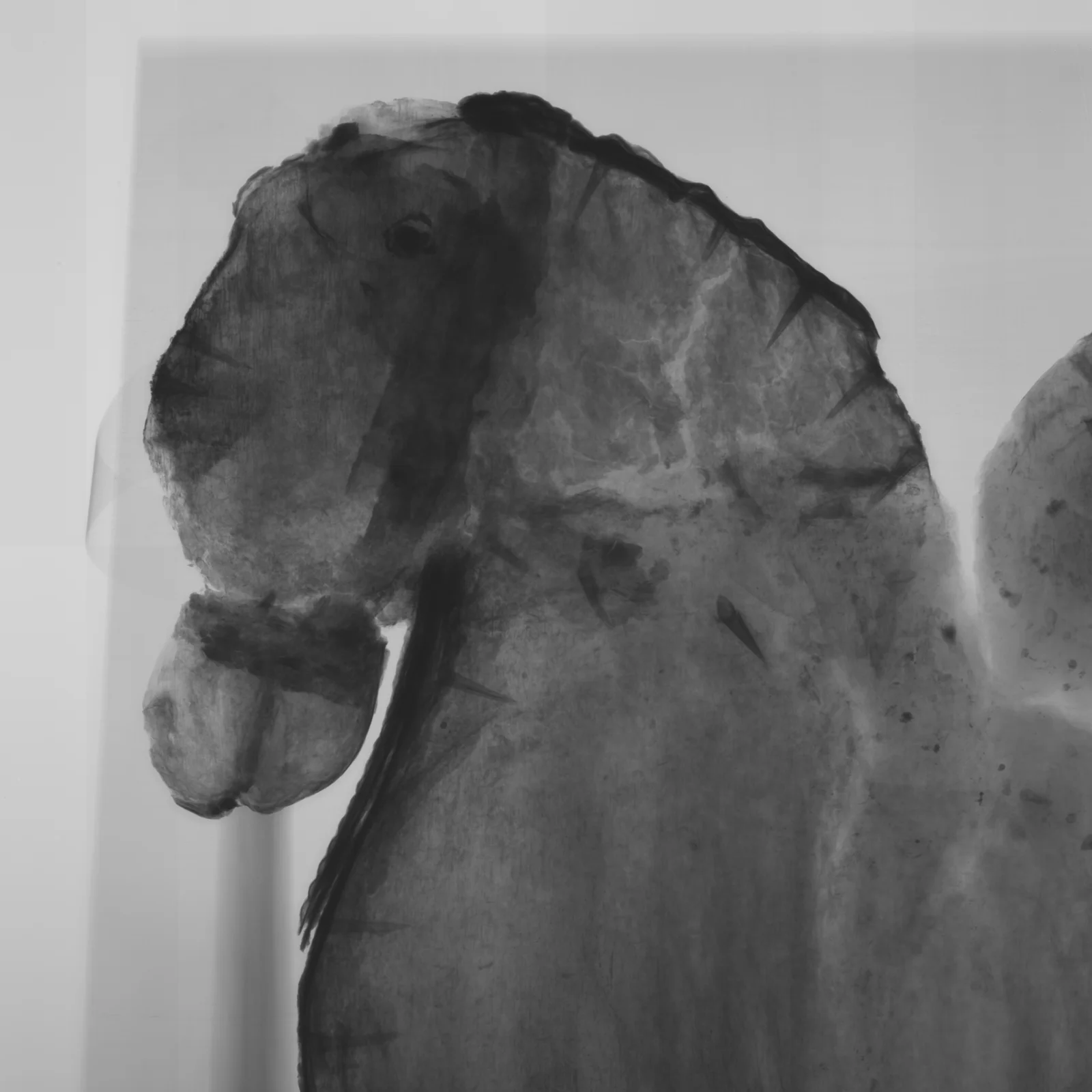
2D X-ray radiograph of the horse’s head.
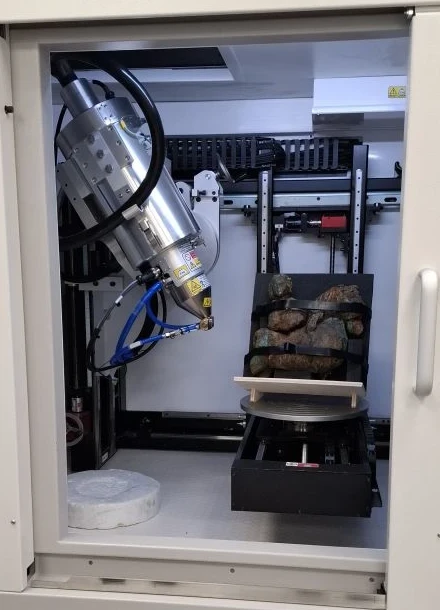
The sample installed in the tomograph enclosure, held on the rotation stage.
The results: data for a tailor-made restoration protocol
The reconstruction provides cross-sectional views along several planes and a 3D model of the work, on which direct measurements can be made. This is valuable data that will make it possible to establish a tailor-made restoration protocol and to design a suitable support.
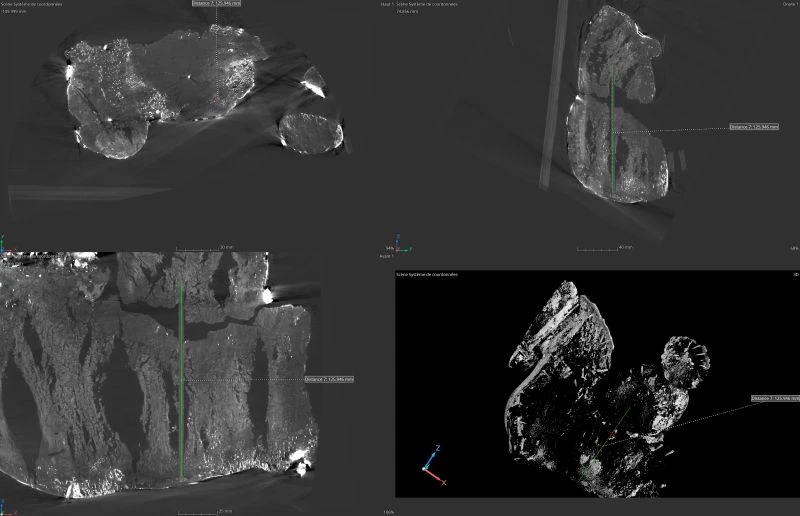
Cross-sectional views along three planes and 3D reconstruction of the sculpture, with dimensional measurement tool.
By revealing the invisible, tomography offers a better understanding of the work and helps to document its history.
A zoomed scan at 16 µm was also carried out on the horse’s tail, in order to provide data on the wood for a possible dendrochronological study. The inspection report, images and videos were sent to ARC-Nucléart.
The INSIDIX advantage for research and heritage
It is not every day that you can boast of having worked on the representation of a goddess! Whether for ancient statues, rocket flight parts or the latest-generation electronic components, INSIDIX is here to support you with your imaging challenges. Also discover our approach for the Research and Universities sector and our multi-technique analysis laboratory.
Thank you to the Sens museums and to ARC-Nucléart for their trust on this very beautiful project, and we look forward to working together again on future subjects.